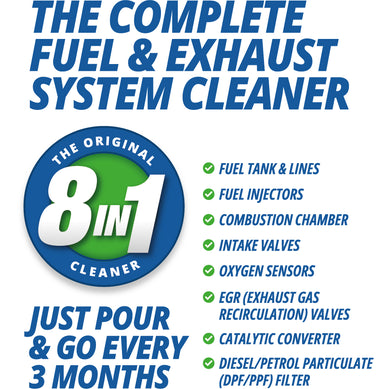
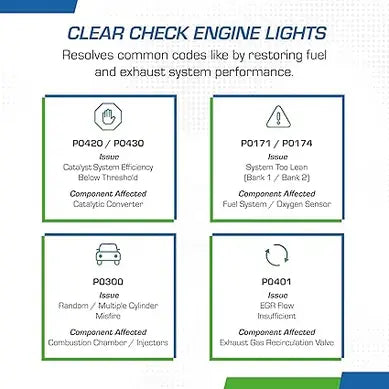
- Fuel Tank and Lines
- Fuel Injectors
- Combustion Chamber
- Intake Valves
- Oxygen Sensors
- EGR (Exhaust Gas Recirculation) Valves
- Catalytic Converter
- Diesel/Petrol Particulate (DPF/PPF) Filter
SAFETY INFORMATION:
SAFETY DATA SHEET
CATACLEAN CHEMICAL BLEND
Page: 1
Compilation date:
15/10/2020
Revision date: 05.01.22
Revision No: 10
Section 1: Identification of the substance/mixture and of the company/undertaking
1.1. Product identifier
Product name: CATACLEAN CHEMICAL BLEND
Product code: HC1515
Synonyms: HC1515
1.2. Relevant identified uses of the substance or mixture and uses advised against
Use of substance / mixture: PC35: Washing and cleaning products (including solvent based products).
1.3. Details of the supplier of the safety data sheet
Company name: CATACLEAN GLOBAL LIMITED
Unit 34, Wellington Employment Park
30 - 48 Dunes Way
Liverpool
Merseyside
L5 9RJ
United Kingdom
Tel: +44(0)151 236 2324
Fax: +44(0)151 236 5271
Email: cataclean@me.com
1.4. Emergency telephone number
Emergency tel: +44(0)151 236 2324
(office hours only)
Section 2: Hazards identification
2.1. Classification of the substance or mixture
Classification under CLP: Most important adverse effects: Asp. Tox. 1: H304; Eye Irrit. 2: H319; Flam. Liq. 2: H225; Skin Irrit. 2: H315; STOT SE 3:
H336; Aquatic Chronic 3: H412; STOT RE 2: H373; -: EUH066
Repeated exposure may cause skin dryness or cracking. Highly flammable liquid and
vapour. May be fatal if swallowed and enters airways. Causes skin irritation. Causes
serious eye irritation. May cause drowsiness or dizziness.
2.2. Label elements
Label elements:
Hazard statements: EUH066: Repeated exposure may cause skin dryness or cracking.
H225: Highly flammable liquid and vapour.
[cont...]SAFETY DATA SHEET
(SYSTEM) CATACLEAN
Page: 2
H304: May be fatal if swallowed and enters airways.
H315: Causes skin irritation.
H319: Causes serious eye irritation.
H336: May cause drowsiness or dizziness.
Hazard pictograms: GHS02: Flame
GHS07: Exclamation mark
GHS08: Health hazard
Signal words: Danger
Precautionary statements: P102: Keep out of reach of children.
P210: Keep away from heat, hot surfaces, sparks, open flames and other ignition
sources. No smoking.
P260: Do not breathe vapours.
P280: Wear protective gloves/protective clothing/eye protection/face protection.
P301+P330+P331: IF SWALLOWED: Rinse mouth. Do NOT induce vomiting
P302+P350: IF ON SKIN: Gently wash with plenty of soap and water.
P304+P340: IF INHALED: Remove person to fresh air and keep comfortable for
breathing.
P305+P351+P338: IF IN EYES: Rinse cautiously with water for several minutes. Remove
contact lenses, if present and easy to do. Continue rinsing.
P314: Get medical advice/attention if you feel unwell.
Haz. ingredients (label): Contains:
XYLENE (MIXED ISOMERS)
PROPAN-2-OL
ACETONE
ALIPHATIC HYDROCARBON SOLVENT BLEND
2.3. Other hazards
Other hazards: PBT: In use, may form flammable / explosive dust-air mixture.
This product is not identified as a PBT/vPvB substance.
Section 3: Composition/information on ingredients
3.2. Mixtures
Hazardous ingredients:
[cont...]SAFETY DATA SHEET
(SYSTEM) CATACLEAN
Page: 3
XYLENE (MIXED ISOMERS) - REACH registered number(s): 01-2119-9488-216-32-XXXX
EINECS CAS PBT / WEL CLP Classification Percent
215-535-7 1330-20-7 - Flam. Liq. 3: H226; Acute Tox. 4:
H312+H332; STOT RE 2: H373; STOT
SE 3: H335; Asp. Tox. 1: H304; Aquatic
Chronic 3: H412; Skin Irrit. 2: H315;
Eye Irrit. 2: H319
30-50%
PROPAN-2-OL - REACH registered number(s): 01-2119457558-25
200-661-7 67-63-0 - Flam. Liq. 2: H225; Eye Irrit. 2: H319;
STOT SE 3: H336
10-30%
ACETONE - REACH registered number(s): 01-2119471330-49-XXXX
200-662-2 67-64-1 - Flam. Liq. 2: H225; Eye Irrit. 2: H319;
STOT SE 3: H336; -: EUH066
10-30%
HYDROCARBONS, C11-C14, ISOALKANES, LOW AROMATICS - REACH registered number(s): 01-2119456620-43-
XXXX
926-141-6 64742-47-8 - Asp. Tox. 1: H304; -: EUH066 1-10%
TOLUENE
203-625-9 108-88-3 - Flam. Liq. 2: H225; Repr. 2: H361d;
Asp. Tox. 1: H304; STOT RE 2: H373;
Skin Irrit. 2: H315; STOT SE 3: H336
<1%
Section 4: First aid measures
4.1. Description of first aid measures
Skin contact: Eye contact: Ingestion: Inhalation: Remove all contaminated clothes and footwear immediately unless stuck to skin. Wash
immediately with plenty of soap and water.
Bathe the eye with running water for 15 minutes. Transfer to hospital for specialist
examination.
Wash out mouth with water. Do not induce vomiting. If conscious, give half a litre of water
to drink immediately. Transfer to hospital as soon as possible.
Remove casualty from exposure ensuring one's own safety whilst doing so. Move to
fresh air in case of accidental inhalation of vapours. If conscious, ensure the casualty
sits or lies down. Transfer to hospital as soon as possible.
4.2. Most important symptoms and effects, both acute and delayed
Skin contact: Eye contact: Ingestion: Inhalation: There may be redness or whiteness of the skin in the area of exposure. Irritation or pain
may occur at the site of contact.
There may be severe pain. The eyes may water profusely.
There may be soreness and redness of the mouth and throat. There may be vomiting.
Convulsions may occur. There may be loss of consciousness.
There may be shortness of breath with a burning sensation in the throat. Absorption
[cont...]SAFETY DATA SHEET
(SYSTEM) CATACLEAN
Page: 4
Delayed / immediate effects: through the lungs can occur causing symptoms similar to those of ingestion.
Convulsions may occur. There may be loss of consciousness.
Immediate effects can be expected after short-term exposure.
4.3. Indication of any immediate medical attention and special treatment needed
Immediate / special treatment: Eye bathing equipment should be available on the premises.
Section 5: Fire-fighting measures
5.1. Extinguishing media
Extinguishing media: Alcohol resistant foam. Water spray. Carbon dioxide. Dry chemical powder.
5.2. Special hazards arising from the substance or mixture
Exposure hazards: Highly flammable. In combustion emits toxic fumes. Forms explosive air-vapour mixture.
Vapour may travel considerable distance to source of ignition and flash back.
5.3. Advice for fire-fighters
Advice for fire-fighters: Wear self-contained breathing apparatus. Wear protective clothing to prevent contact
with skin and eyes.
Section 6: Accidental release measures
6.1. Personal precautions, protective equipment and emergency procedures
Personal precautions: Refer to section 8 of SDS for personal protection details. Notify the police and fire
brigade immediately. Turn leaking containers leak-side up to prevent the escape of
liquid. Eliminate all sources of ignition.
6.2. Environmental precautions
Environmental precautions: Do not discharge into drains or rivers. Contain the spillage using bunding. Alert the
neighbourhood to the presence of fumes or gas.
6.3. Methods and material for containment and cleaning up
Clean-up procedures: Clean-up should be dealt with only by qualified personnel familiar with the specific
substance. Absorb into dry earth or sand. Do not use equipment in clean-up procedure
which may produce sparks. Ventilate area well. Extinguish all ignition sources. Avoid
sparks, flames, smoking and any other heat source. Leaking material will evaporate
leaving no residues.
6.4. Reference to other sections
Reference to other sections: Refer to section 8 of SDS.
Section 7: Handling and storage
7.1. Precautions for safe handling
Handling requirements: Avoid direct contact with the substance. Avoid the formation or spread of mists in the air.
[cont...]SAFETY DATA SHEET
(SYSTEM) CATACLEAN
Ensure there is sufficient ventilation of the area. Smoking is forbidden. Use non-
sparking tools. Do not handle in a confined space.
Page: 5
7.2. Conditions for safe storage, including any incompatibilities
Storage conditions: Suitable packaging: Store in a cool, well ventilated area. Keep container tightly closed. Keep away from
sources of ignition. Prevent the build up of electrostatic charge in the immediate area.
Ensure lighting and electrical equipment are not a source of ignition.
Must only be kept in original packaging.
7.3. Specific end use(s)
Specific end use(s): No data available.
Section 8: Exposure controls/personal protection
8.1. Control parameters
Hazardous ingredients:
XYLENE (MIXED ISOMERS)
Workplace exposure limits: Respirable dust:
State 8 hour TWA 15 min. STEL 8 hour TWA 15 min. STEL
EU 50ppm 100ppm - -
PROPAN-2-OL
UK 400 ppm 500 ppm - -
ACETONE
UK 1210 mg/m3 3620 mg/m3 - -
HYDROCARBONS, C11-C14, ISOALKANES, LOW AROMATICS
UK 1200 mg/cm3 - - -
TOLUENE
UK 191 mg/m3 384 mg/m3 - -
DNEL/PNEC Values
DNEL / PNEC No data available.
8.2. Exposure controls
Engineering measures: Respiratory protection: Hand protection: Eye protection: Ensure there is sufficient ventilation of the area. Ensure lighting and electrical
equipment are not a source of ignition.
Self-contained breathing apparatus must be available in case of emergency. Gas/vapour
filter, type A: organic vapours (EN141).
Gloves (solvent-resistant). Gloves made of thick material. Nitrile gloves. Breakthrough
time of the glove material > 1 hour.
Safety glasses with side-shields. Ensure eye bath is to hand.
[cont...]SAFETY DATA SHEET
(SYSTEM) CATACLEAN
Page: 6
Skin protection: Impermeable protective clothing.
Section 9: Physical and chemical properties
9.1. Information on basic physical and chemical properties
State: Liquid
Colour: Colourless
Odour: Characteristic odour
Viscosity: Non-viscous
Boiling point/range°C: 56 - 280 Flammability limits %: lower: 0.5 Flash point°C: 24 Autoflammability°C: >200 Relative density: 0.825 VOC g/l: 825
Melting point/range°C: No data available.
upper: 14.3
Part.coeff. n-octanol/water: No data available.
Vapour pressure: No data available.
pH: Not applicable.
9.2. Other information
Other information: No data available.
Section 10: Stability and reactivity
10.1. Reactivity
Reactivity: Stable under recommended transport or storage conditions.
10.2. Chemical stability
Chemical stability: Stable under normal conditions. Stable at room temperature.
10.3. Possibility of hazardous reactions
Hazardous reactions: Hazardous reactions will not occur under normal transport or storage conditions.
Decomposition may occur on exposure to conditions or materials listed below.
10.4. Conditions to avoid
Conditions to avoid: Heat. Hot surfaces. Flames. Sources of ignition.
10.5. Incompatible materials
Materials to avoid: Strong oxidising agents. Strong acids.
10.6. Hazardous decomposition products
Haz. decomp. products: In combustion emits toxic fumes.
Section 11: Toxicological information
11.1. Information on toxicological effects
[cont...]SAFETY DATA SHEET
(SYSTEM) CATACLEAN
Hazardous ingredients:
XYLENE (MIXED ISOMERS)
DERMAL RBT LD50 >5000 mg/kg
ORAL RAT LD50 >5000 mg/kg
VAPOURS RAT 4H LC50 >5000 ppmV
PROPAN-2-OL
ORAL RAT LD50 4700 mg/kg
ORAL RBT LD50 >2000 mg/kg
VAPOURS RAT 4H LC50 46.5 mg/l
ACETONE
IVN RAT LD50 5500 mg/kg
ORL MUS LD50 3000 mg/kg
ORL RAT LD50 5800 mg/kg
HYDROCARBONS, C11-C14, ISOALKANES, LOW AROMATICS
DERMAL RBT LD50 >5000 mg/kg
ORAL RAT LD50 >5000 mg/kg
VAPOURS RAT 4H LC50 >5000 mg/kg
TOLUENE
IVN RAT LD50 1960 mg/kg
ORL MUS LD50 2 gm/kg
ORL RAT LD50 6900 mg/kg
Relevant hazards for product:
Hazard Route Basis
Skin corrosion/irritation DRM Hazardous: calculated
Serious eye damage/irritation OPT Hazardous: calculated
STOT-single exposure - Hazardous: calculated
STOT-repeated exposure - Hazardous: calculated
Aspiration hazard - Hazardous: calculated
Symptoms / routes of exposure
Skin contact: Eye contact: Ingestion: There may be redness or whiteness of the skin in the area of exposure. Irritation or pain
may occur at the site of contact.
There may be severe pain. The eyes may water profusely.
There may be soreness and redness of the mouth and throat. There may be vomiting.
Convulsions may occur. There may be loss of consciousness.
Page: 7
[cont...]Inhalation: Delayed / immediate effects: SAFETY DATA SHEET
(SYSTEM) CATACLEAN
There may be shortness of breath with a burning sensation in the throat. Absorption
through the lungs can occur causing symptoms similar to those of ingestion.
Convulsions may occur. There may be loss of consciousness.
Immediate effects can be expected after short-term exposure.
Page: 8
Section 12: Ecological information
12.1. Toxicity
Hazardous ingredients:
XYLENE (MIXED ISOMERS)
ALGAE 72H IC50 2.2 mg/l
Daphnia magna 48H EC50 2930-4400 µg/l
RAINBOW TROUT (Oncorhynchus mykiss) 96H LC50 4200 µg/l
PROPAN-2-OL
Daphnia magna 48H EC50 >100 mg/l
FISH 48H EC50 >100 mg/l
ACETONE
BLUEGILL (Lepomis macrochirus) LC50 8300 mg/l
HYDROCARBONS, C11-C14, ISOALKANES, LOW AROMATICS
Daphnia magna 48H EC50 >250 mg/l
RAINBOW TROUT (Oncorhynchus mykiss) 96H LC50 >1000 mg/l
12.2. Persistence and degradability
Persistence and degradability: Biodegradable.
12.3. Bioaccumulative potential
Bioaccumulative potential: No bioaccumulation potential.
12.4. Mobility in soil
Mobility: Readily absorbed into soil. Volatile. Insoluble in water. Floats on water. Vapour is heavier
than air.
12.5. Results of PBT and vPvB assessment
PBT identification: This product is not identified as a PBT/vPvB substance.
12.6. Other adverse effects
Other adverse effects: Harmful to aquatic organisms.
[cont...]SAFETY DATA SHEET
(SYSTEM) CATACLEAN
Page: 9
Section 13: Disposal considerations
13.1. Waste treatment methods
Disposal operations: Transfer to a suitable container and arrange for collection by specialised disposal
company.
Recovery operations: Solvent reclamation/regeneration.
Waste code number: 20 01 13
Disposal of packaging: NB: Dispose of as normal industrial waste. Clean with water.
The user's attention is drawn to the possible existence of regional or national
regulations regarding disposal.
Section 14: Transport information
14.1. UN number
UN number: UN1993
14.2. UN proper shipping name
Shipping name: FLAMMABLE LIQUID, N.O.S.
14.3. Transport hazard class(es)
Transport class: 3
14.4. Packing group
Packing group: III
14.5. Environmental hazards
Environmentally hazardous: No Marine pollutant: No
14.6. Special precautions for user
Special precautions: No special precautions.
Tunnel code: D/E
Transport category: 3
Section 15: Regulatory information
15.1. Safety, health and environmental regulations/legislation specific for the substance or mixture
Specific regulations: Not applicable.
15.2. Chemical Safety Assessment
Chemical safety assessment: A chemical safety assessment has not been carried out for the substance or the mixture
by the supplier.
Section 16: Other information
[cont...]SAFETY DATA SHEET
(SYSTEM) CATACLEAN
Page: 10
Other information
Other information: Phrases used in s.2 and s.3: Legal disclaimer: This safety data sheet is prepared in accordance with Commission Regulation (EU) No
2015/830.
EUH066: Repeated exposure may cause skin dryness or cracking.
H225: Highly flammable liquid and vapour.
H226: Flammable liquid and vapour.
H304: May be fatal if swallowed and enters airways.
H312+H332: Harmful in contact with skin or if inhaled
H315: Causes skin irritation.
H319: Causes serious eye irritation.
H335: May cause respiratory irritation.
H336: May cause drowsiness or dizziness.
H361d: Suspected of damaging the unborn child.
H373: May cause damage to organs through prolonged or repeated exposure.
H412: Harmful to aquatic life with long lasting effects.
The above information is believed to be correct but does not purport to be all inclusive
and shall be used only as a guide. This company shall not be held liable for any
damage resulting from handling or from contact with the above product.